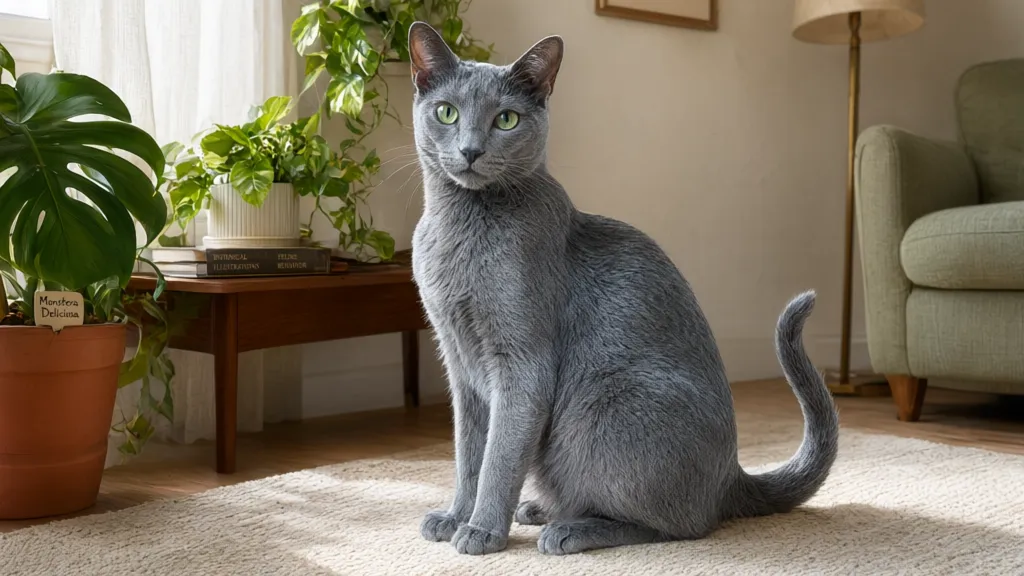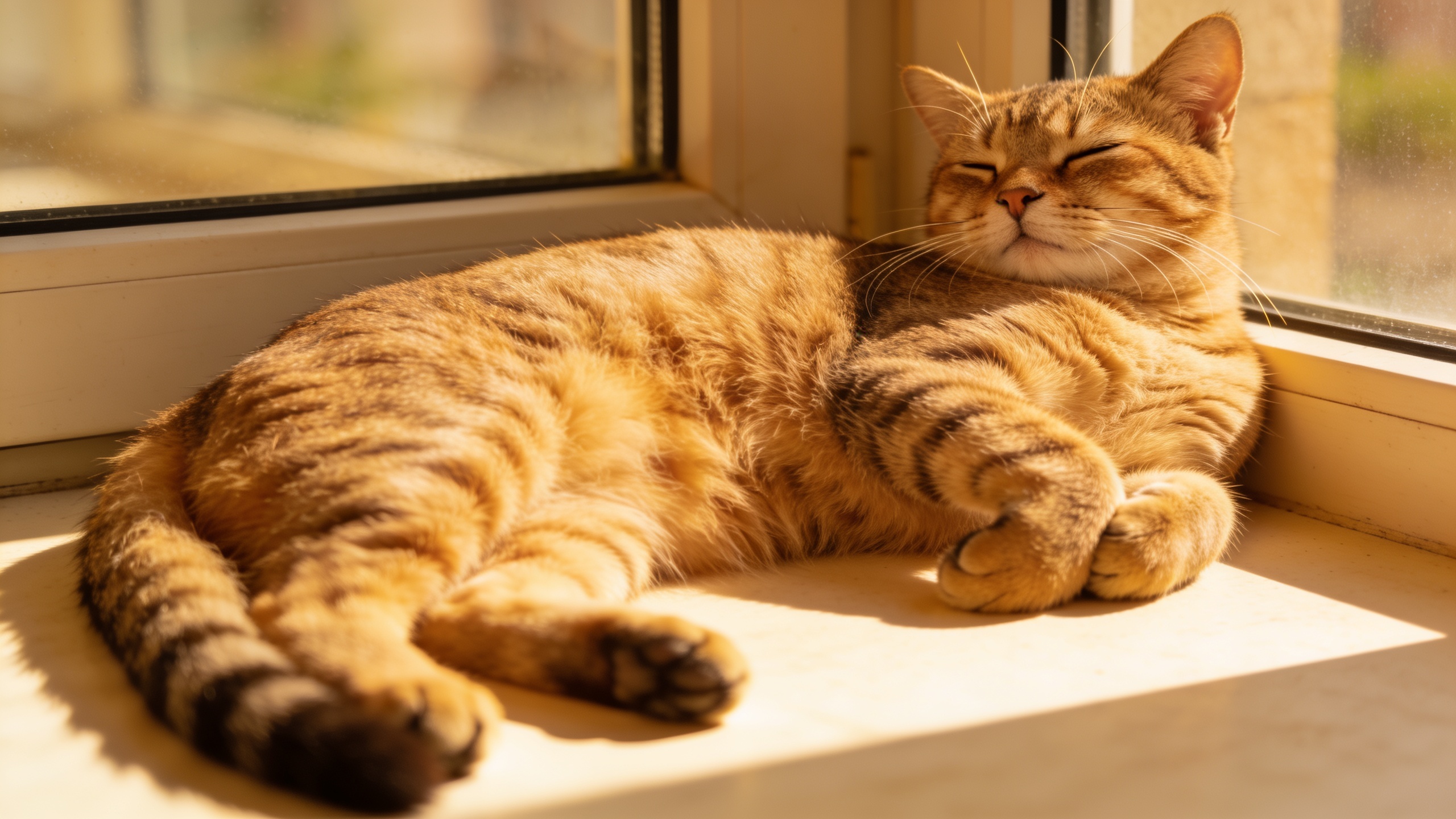
A relaxed, content cat shows a body that’s economical rather than compressed or inflated: weight evenly distributed, muscles soft, paws tucked loosely or one hind leg extended, and the tail resting in a neutral line or wrapped gently around the body. The ears sit forward or slightly outward with no continual pivoting, and the whiskers project naturally from the muzzle instead of being pulled tightly back or pushed rigidly forward. The eyes are open but not hard; slow blinking reflects low arousal and a secure emotional state because the cat does not need to maintain constant vigilance. Dilated pupils can occur in dim light or during play, so pupil size must be interpreted with posture, movement, and facial tension rather than alone.
Happy cats often seek proximity without demanding it. They may choose to sit near a person, lean against a leg, or follow from room to room, which indicates social affiliation rather than dependency when paired with a loose body and the ability to disengage. Head-bunting, cheek rubbing, and weaving under a hand are scent-marking behaviors driven by facial glands and are strongest when the cat feels safe enough to advertise ownership of the social environment. A cat that initiates contact, then remains loose during petting, is signaling that interaction is self-reinforcing; a cat that approaches and then stiffens, tail-flicks, or leaves is not expressing contentment and should not be mislabeled as “affectionate.”
Vocal patterns also matter. Soft chirps, trills, and brief conversational meows are commonly associated with positive arousal and social engagement, while persistent, escalating meowing usually reflects unmet needs, frustration, pain, or learned attention-seeking rather than happiness. Purring is not a reliable happiness marker on its own; cats may purr during nursing, social contact, feeding anticipation, and self-soothing in discomfort. The combination that best supports a positive state is purring with loose limbs, normal grooming, a stable appetite, and easy transitions between rest and movement.
Play is one of the clearest indicators of psychological well-being when it remains species-typical and controlled. A happy cat will stalk, pounce, bat, and sprint in short bursts, then recover quickly, without frantic escalation or compulsive repetition. Kittens and adolescents show this most intensely, but adult cats also need predatory play outlets; absence of play in a cat that once played can signal pain, arthritis, dental disease, or depression-like withdrawal. Cats with adequate environmental enrichment display normal exploratory behavior, use vertical space, and rest in open areas without excessive startle responses.

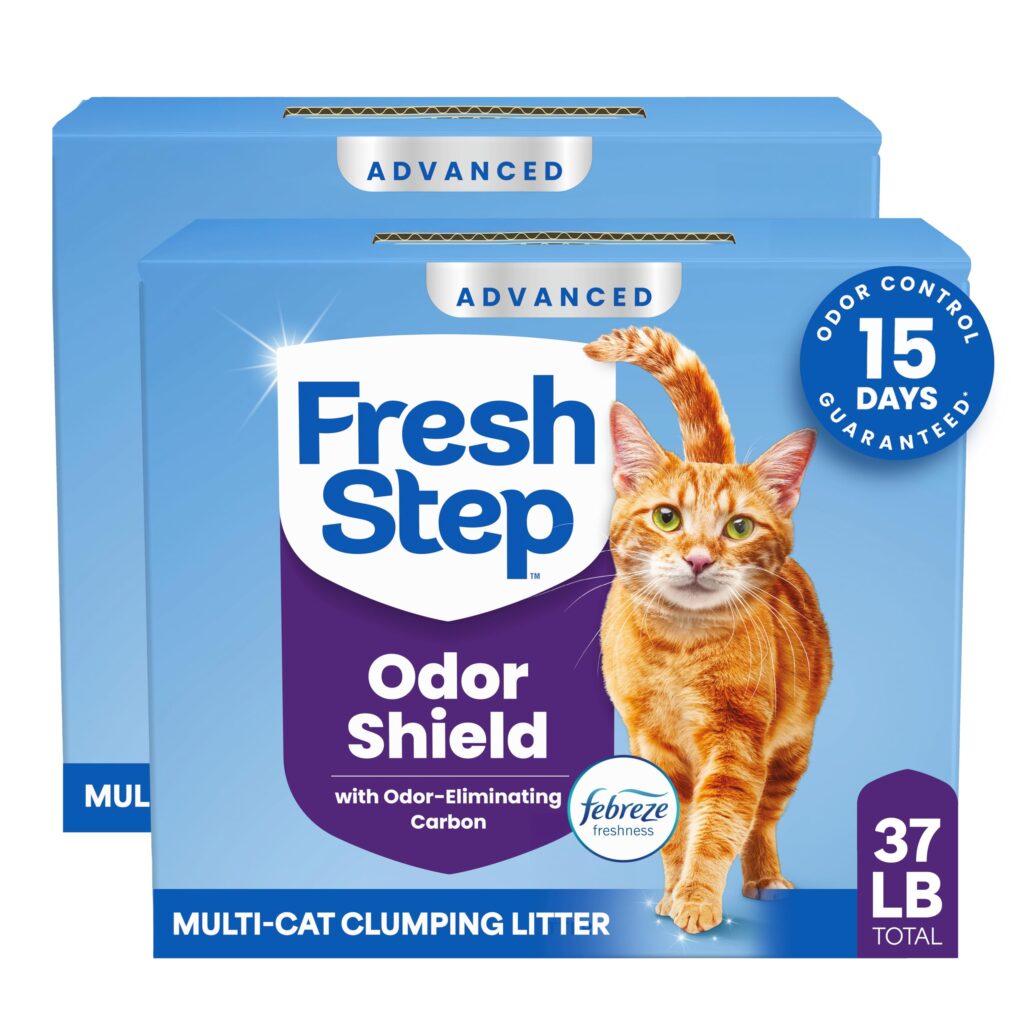
Fresh Step Advanced Odor Shield Clumping Cat Litter with Gain, 18.5 lb, 2Pk | Odor Shield with Ammonia Block Technology, Low Dust, Multi Cat, Compatible with Most Automatic Litter Boxes
EUR 28.78 (as of October 3, 2026 19:10 GMT +00:00 - More infoProduct prices and availability are accurate as of the date/time indicated and are subject to change. Any price and availability information displayed on [relevant Amazon Site(s), as applicable] at the time of purchase will apply to the purchase of this product.)Other signs of emotional stability include regular self-grooming, predictable sleep-wake cycles, normal litter box use, and a willingness to eat in the presence of household activity. A cat that comfortably exposes the abdomen is not always inviting touch, but the position itself usually reflects trust because the vulnerable ventral surface is not being guarded. Breed tendencies can affect expression: more vocal or people-oriented lines such as Siamese, Burmese, and Ragdolls often show happiness with overt social contact, whereas many British Shorthairs, Russian Blues, and Norwegian Forest Cats may express contentment more subtly through proximity, slow blinking, and calm body posture.
Age and health change the picture. Senior cats may look less exuberant but still be emotionally well if they maintain interest in routine, food, and social contact; reduced jump height, slower grooming, and shorter play bouts may reflect osteoarthritis rather than mood. Nutrition influences behavioral presentation: cats on highly palatable, frequent-meal schedules may appear more engaged and relaxed because stable energy intake reduces food-related frustration, while dehydration or insufficient protein can blunt activity and social initiative. A truly happy cat is not merely still; it is relaxed, responsive, and able to move between rest, social contact, exploration, and play without signs of tension.
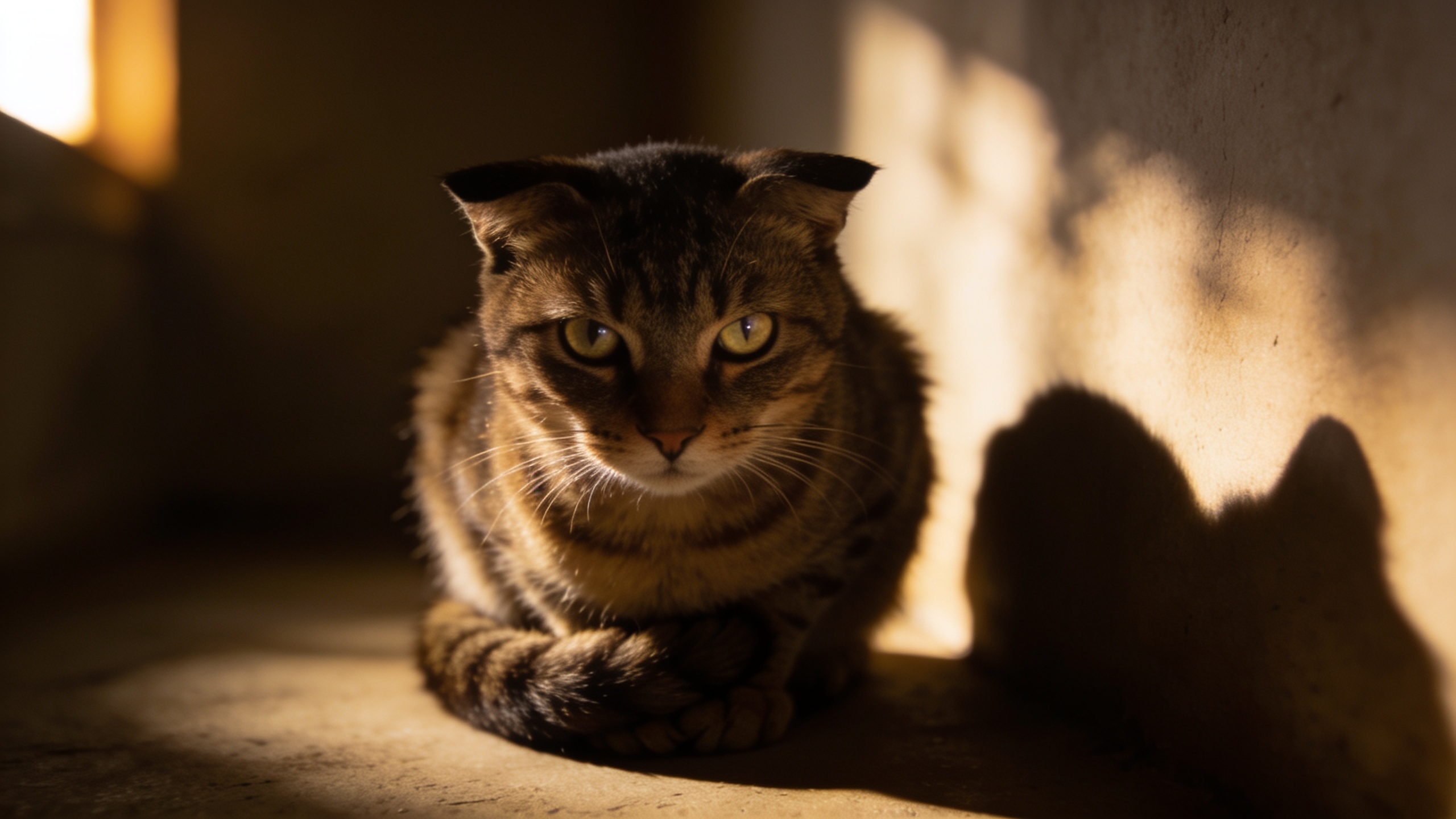
An anxious cat is usually guarded before it becomes obviously reactive. The first clues are reduced body size and reduced movement: crouching low, weight shifted backward, shoulders tucked, and the tail wrapped tightly around the body or held close with the tip twitching. Ears rotate sideways or flatten intermittently because the cat is scanning for threat while trying to keep the ears protected. Whiskers pulled back against the cheeks, a closed or squinting mouth, and a head held low with the chin tucked all indicate increased vigilance rather than relaxation. Unlike a sleepy cat, an anxious cat often looks as if it is trying to make itself harder to notice.
Pupil dilation is one of the most useful indicators when it matches the rest of the posture. In anxiety, pupils may remain enlarged even in normal light because sympathetic arousal prepares the body for escape or defense. This state is often accompanied by freezing, slow retreat, or sudden darting movements toward cover. A cat that alternates between immobility and rapid repositioning is not calm; it’s attempting to balance concealment with the need to monitor the environment. Excessive scanning, frequent head turns, and a refusal to settle in open areas are common in cats living with chronic noise, unfamiliar animals, conflict over resources, or pain.
Behaviorally, anxiety often appears as displacement activities and low-level avoidance. Overgrooming, especially on the flanks, abdomen, or forelegs, can be a self-soothing response to stress and may progress to coat thinning or skin inflammation. Repeated lip licking, yawning, nose licking, sudden scratching, or brief grooming interruptions can reflect conflict rather than hygiene. A cat that leaves the room when approached, eats only when alone, or uses the litter box quickly and with scanning behavior may be showing stress related to social pressure, territorial insecurity, or unpleasant associations with the area.
Anger or fear-aggression usually builds from the same arousal state but adds defensive intent. The cat becomes larger rather than smaller: hair may piloerect along the spine and tail, the back may arch, and the tail may lash with broad, forceful movements. Ears flatten fully or angle outward in an “airplane” position, pupils stay wide, and the cat may fixate on the target with a hard stare. A low growl, hiss, spit, yowl, or rapid swatting signals that threshold has been crossed. Many cats do not attack without warning; the warning sequence is often visible for several seconds to minutes if the observer knows what to watch for.
Context matters because anger in cats is frequently fear-based. Painful handling, cornering, eye contact that feels threatening, restraint during grooming or medication, and competition near food or resting sites can trigger defensive aggression. Cats with hyperthyroidism, dental pain, arthritis, urinary discomfort, or cognitive decline may show irritability because their baseline tolerance is lowered. Sudden aggression in a previously tolerant cat should always raise suspicion for medical discomfort rather than “bad temperament.” In intact males, territorial conflict and mate-related frustration can intensify aggression, while queens nursing kittens may defend a nest with a far shorter fuse.
Breed and developmental differences change the threshold, not the underlying meaning. Highly social or vocal breeds may communicate stress more audibly, while more reserved breeds may default to stillness and avoidance until they feel trapped. Kittens often escalate quickly because they have not yet learned inhibition, whereas adult cats with repeated negative experiences may show a rapid switch from withdrawal to attack. Nutrition can influence arousal as well: inconsistent feeding, low protein intake, dehydration, and abrupt diet changes can increase irritability, particularly in cats already stressed by environmental instability. Chronic anxiety often becomes easier to detect in cats whose appetite, litter use, grooming, or sleep pattern has shifted alongside these body-language changes.
When a cat is anxious or angry, the key question is not whether it’s “being difficult,” but what pressure is exceeding its coping capacity: pain, fear, territorial insecurity, or unresolved frustration.