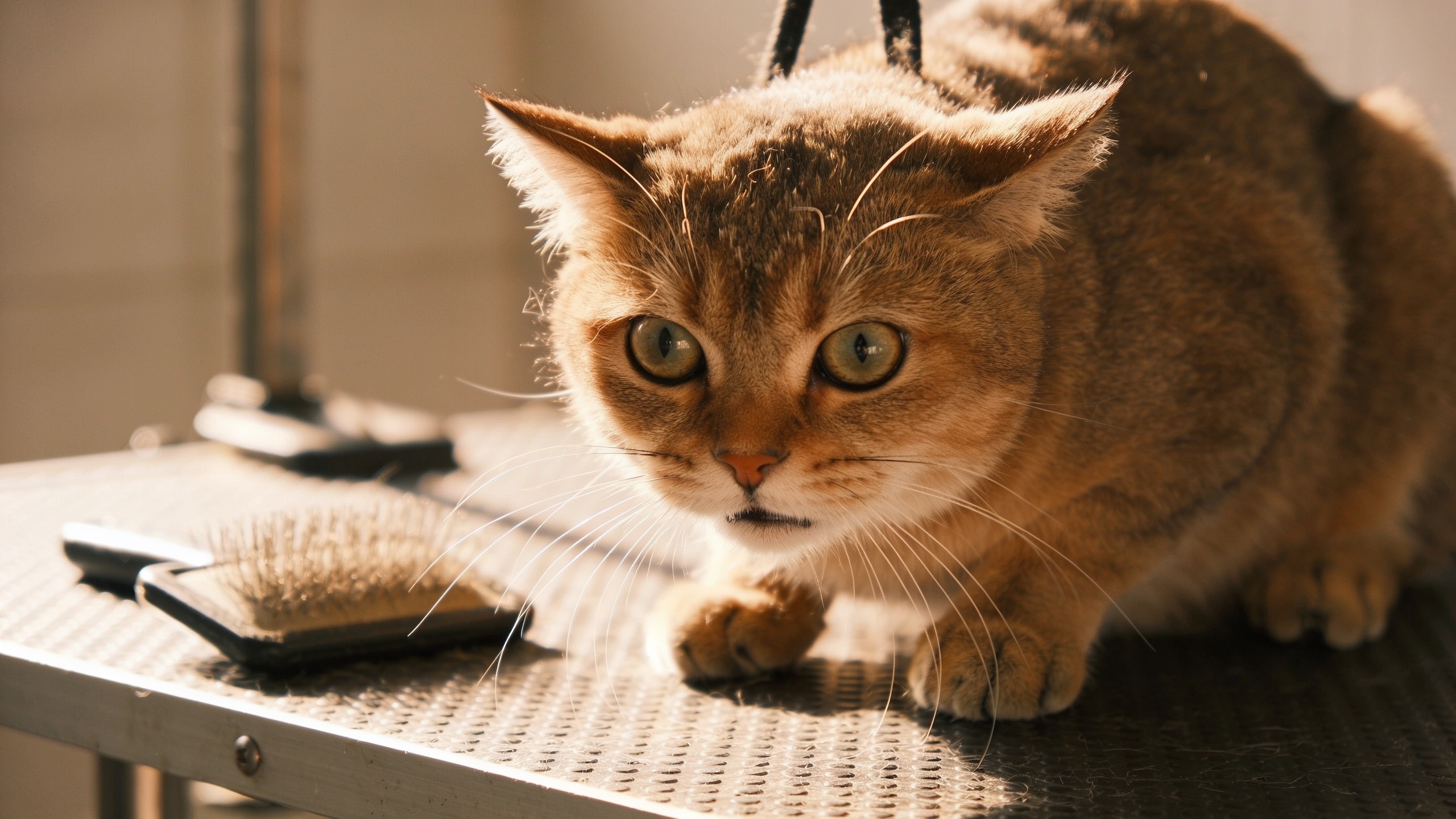
Grooming stress in cats is often expressed long before a bite or scratch occurs, and the earliest signs are usually subtle changes in body language rather than overt aggression. A cat that is becoming overloaded will typically stop accepting handling cleanly: the muscles tighten, the skin ripples along the back or flanks, the tail begins to twitch or lash in a tight arc, the ears rotate sideways or flatten, and the pupils dilate even in normal light. Many cats first signal discomfort by shifting weight away from the brush, turning the head to monitor the hand, or freezing instead of relaxing into the session. Freezing is not tolerance; it’s a common pre-aggressive state in which the cat is suppressing movement while stress hormones rise.
Facial changes are especially useful because cats often mask distress with stillness. Look for whiskers that thrust forward when the cat is preparing to strike or pull back and flatten against the cheeks when avoidance is increasing, a mouth that clamps shut, rapid nose licking, and a brief “air bite” or jaw snap. Some cats show piloerection in localized patches, especially over the shoulders and lower back, reflecting sympathetic nervous system activation. When a cat’s grooming tolerance drops suddenly, consider pain before assuming behavior alone; arthritis, hip dysplasia, dental disease, skin inflammation, and otitis can make coat care feel invasive because the brush or comb moves tissue that already hurts. Senior cats commonly resent grooming at the spine, base of tail, or hindquarters because degenerative joint pain reduces their ability to reposition comfortably.
Behavioral escalation usually follows a predictable pattern: tolerance, then avoidance, then defensive action. Avoidance may look like leaving the room when the brush appears, hiding after being lifted onto a table, or becoming “busy” with exaggerated self-grooming to redirect the interaction. As stress rises, vocalization may change from normal purring to low grumbling, hissing, growling, or a sharp yowl, but some cats remain silent until the final warning. A tail that thumps or a body that shifts into a crouch with lowered head and compressed paws indicates the cat is preparing to disengage or defend itself. Repeated tail flicking during brushing is not mild annoyance; it is a measurable indicator that the threshold is being approached.
Coat and skin clues can tell you whether the problem is emotional, medical, or both. Mats under the armpits, behind the ears, along the flanks, and at the pantaloon area can create pain with even light brushing, especially in longhaired breeds such as Persians, Ragdolls, Maine Coons, and Norwegian Forest Cats. Cats with seborrhea, flea allergy dermatitis, atopy, ringworm, or eosinophilic skin disease may react because the tool pulls at inflamed follicles or exposes tender lesions. If the cat flinches consistently at one region, overgrooms the same area afterward, or reacts more strongly to combing than stroking, inspect for heat, redness, scabs, dandruff, greasy coat, parasites, or asymmetric hair loss. Stress that appears only during grooming but not during other handling often reflects learned negative association from past painful sessions, especially in cats that were forced to endure prolonged brushing, mat cutting, or shaving.

Dr. Elsey's Ultra UnScented Clumping Clay Cat Litter 40 lb. Bag
EUR 18.60 (as of October 1, 2026 18:48 GMT +00:00 - More infoProduct prices and availability are accurate as of the date/time indicated and are subject to change. Any price and availability information displayed on [relevant Amazon Site(s), as applicable] at the time of purchase will apply to the purchase of this product.)Risk signs that require stopping the session immediately include dilated pupils with fixed staring, pinned ears, vocal escalation, rapid tail whipping, skin twitching across the back, attempt to flee, crouched posture, swatting, or any bite directed toward the hand, brush, or towel. Once those thresholds are reached, continued handling teaches the cat that escape is impossible, which lowers future grooming tolerance and increases the chance of a true bite. In cats with a history of panic, recognizing the very first signal matters more than finishing the coat: one cat may tolerate five strokes and another only one, and the threshold can vary with pain, environment, time of day, and previous handling. Cats in poor body condition, obese cats unable to reach the hindquarters, and brachycephalic breeds with dense coats often show stress sooner because grooming effort is physically harder and more irritating.
When a cat’s body says “enough,” the next brush stroke does not build trust; it builds a stronger fear memory.
Track patterns across sessions. A cat that starts grooming calmly but becomes reactive after the chest, belly, or rear legs are touched is telling you where tactile sensitivity, joint pain, or lack of control is concentrated. A cat that only protests when restrained is often reacting to loss of agency more than to the brush itself. If stress is present every time, even with brief, careful handling, a veterinary exam is warranted to rule out pain, skin disease, ear disease, or neuropathic sensitivity before modifying technique.
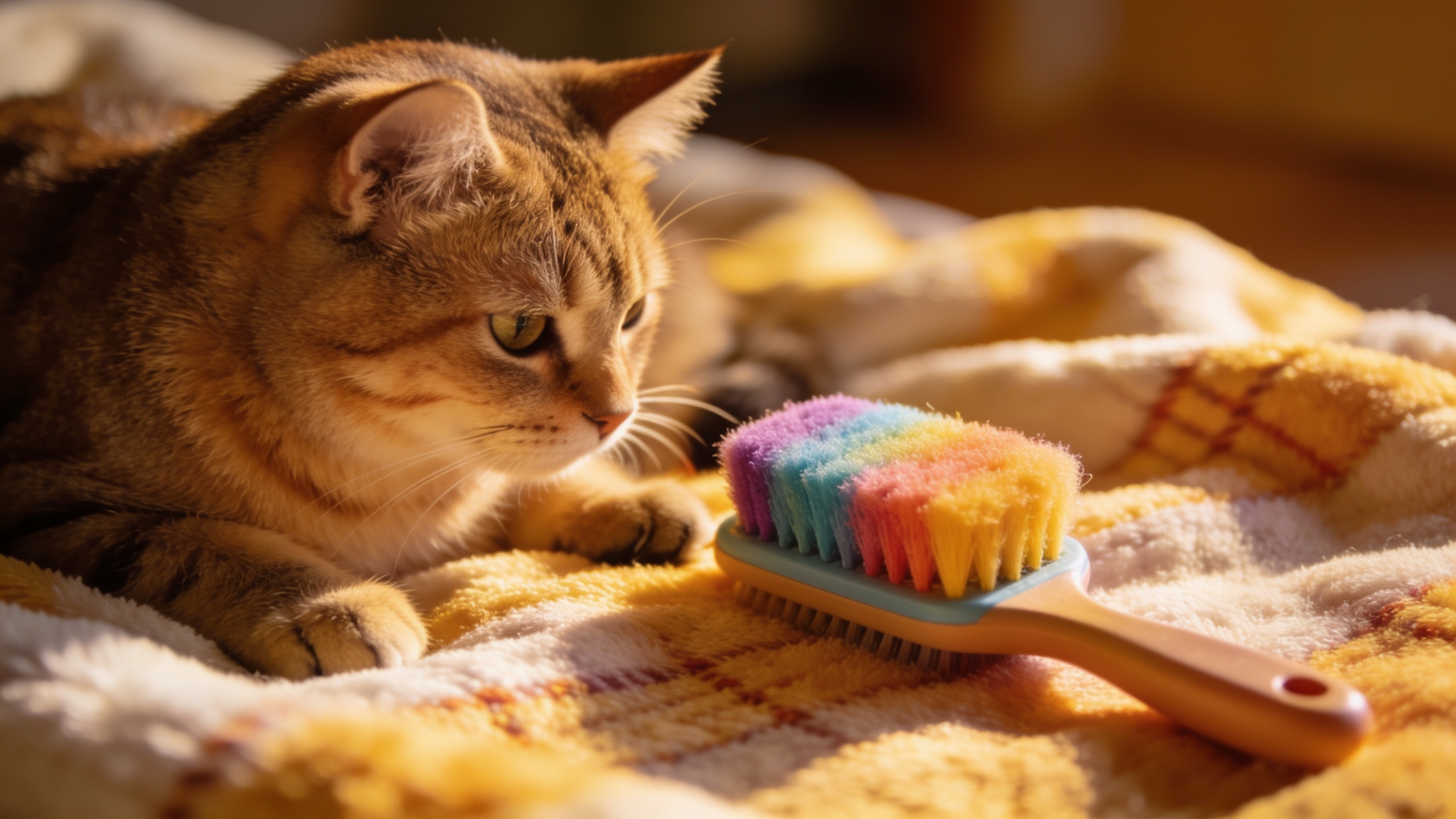
Start by reducing the sensory load before you touch the coat. Cats read grooming as a cluster of inputs: restraint, tool texture, sound, motion, odor, and position. Remove extra noise, use a stable non-slip surface, and keep the cat on a familiar blanket or mat that preserves scent cues and traction. For many anxious cats, the first improvement comes from changing the setting, not the tool. A frightened cat on a slick counter is already spending nervous-system energy on balance, which lowers the threshold for defensive behavior.
Let the cat choose the initial distance and direction of contact whenever possible. Present the brush for inspection, then touch only the preferred zones first, usually the cheeks, chin, or lateral neck, where social grooming is normally accepted and where tactile sensitivity is often lower than over the spine or abdomen. Short, predictable passes are more effective than long strokes because they reduce temporal uncertainty; the cat can predict the end point and does not feel trapped by continuous handling. Stop while the cat is still calm, not when it is already irritated, because ending on tolerance trains cooperation better than pushing to the point of escalation.
Select tools based on coat architecture, skin fragility, and static generation. Soft rubber grooming mitts and ultra-soft slicker brushes are often better tolerated than metal combs in cats with thin skin, geriatric frailty, or inflammatory dermatitis. Longhaired cats with dense undercoats may need a two-step approach: first a wide-tooth comb to separate surface tangles, then a finer comb only where resistance is detected. Never drag a tool through a mat; that shears epidermis and creates a pain memory that can persist for months. If a mat cannot be removed without skin traction, clip or professionally groom it rather than forcing through it.
Pair grooming with high-value food in a way that does not compete with body control. Tiny lickable rewards, delivered after one or two calm passes, help create a predictable sequence: touch, reward, release. This works best when the cat is mildly hungry and the food is highly palatable but not so rich that it causes gastrointestinal upset in sensitive cats. Avoid large meals, which can make some cats restless or reduce interest in treats, and avoid treats high in fat if pancreatitis or obesity is a concern. For diabetic cats or those on strict diets, use a portion of the daily ration as the grooming reward.
Use micro-sessions. For highly reactive cats, one to three strokes may be a complete session. Build duration only after several successful repetitions at the current threshold. If the cat tolerates the chest but not the hindquarters, separate those regions into different sessions rather than trying to finish everything at the same time. The goal is not completeness in one sitting; the goal is to avoid crossing the point where fear conditioning overrides learning. Cats with arthritis often do best when grooming is timed after warmth, rest, or a meal, when muscles are looser and handling feels less intrusive.
- Watch for tail-tip twitching, skin rippling, or head turning away; these are the moment to pause, not continue.
- Keep one hand as a steadying contact and the other as the grooming hand to reduce the sensation of being grabbed.
- Use slow, even pressure rather than rapid repetitive brushing, which can trigger sensory over-responsivity.
- Work in coat layers, lifting only small sections to avoid tugging at the skin.
- For cats that dislike restraint, groom during voluntary side-lying or loaf posture instead of forcing a stand.
If the cat begins to tense as soon as the tool appears, desensitization must happen before full grooming resumes. Place the brush near the resting area without using it, then pair its presence with food until the cat remains relaxed. In genetically dense-coated breeds and in cats with a history of painful grooming, this preview phase can matter more than the actual brushing. A cat that can sniff the brush, accept reward, and leave freely is learning control; a cat this is pinned and brushed is learning helplessness, which makes future grooming harder and more dangerous.