The earliest clues are often so faint that they masquerade as temperament, age, or a passing respiratory annoyance, which is precisely why heartworm disease in cats is so treacherous: the parasite’s footprint is subtle, intermittent, and frequently disproportionate to the number of worms present. A cat may be harboring only one or two immature worms, yet the inflammatory cascade they provoke in the pulmonary arteries and lungs can be dramatic. Watch first for a cough that’s not the dry, hairball-like retching many guardians expect, but a brief, stubborn hack or a wheezy effort that seems to arrive in spells. Some cats show no cough at all and instead develop a sudden, transient episode of labored breathing, as though a switch has been thrown and then just as quickly reset. This can reflect heartworm-associated respiratory disease, in which the cat’s immune system attacks dying larvae or immature worms in the lung vessels, creating a storm of inflammation without the long prelude that dogs so often display.
Behavioral shifts are often the first honest language of illness. A once-lively cat may begin to hide, sleep in unusual places, or withdraw from play not because of moodiness but because every breath has become a negotiation. Subtle exercise intolerance can look like nothing more than abandoning a chase midstream, pausing on the way to a favored perch, or choosing the couch over the window ledge. Cats are masters of compensating until they cannot, and their capacity for dignified concealment is biologically ingrained; in the wild, weakness announces vulnerability. That instinct remains intact in the domestic setting, which means the attentive observer must learn to read what is missing as carefully as what is present. A cat that no longer leaps with her customary confidence, that climbs stairs more slowly, or that seems irritable when handled may be communicating discomfort through restraint rather than complaint.
Breathing pattern is one of the most revealing windows into early disease. A healthy resting cat breathes quietly and efficiently, with the chest moving in a barely perceptible rhythm. Heartworm-injured lungs may produce a quicker resting rate, a shallow abdominal component to respiration, or an open-mouth gasp after only modest exertion; in cats, open-mouth breathing is an emergency sign, never a benign variation. Some cats present with repeated sneezing, a hoarse meow, or a seeming asthma flare, because the inflamed airways constrict and the bronchial tree becomes irritable. Others develop episodic vomiting that has no clear dietary cause. In a cat, vomiting is not a diagnosis but a signal, and when it arrives alongside coughing, reduced appetite, or lethargy, the heartworm puzzle must move higher on the list. A faint fever, decreased grooming, or a coat that begins to lose its satin finish can also accompany systemic inflammation, though these signs are maddeningly nonspecific and easy to overlook in a cat whose natural reserve makes illness appear almost respectable.
There are also the dramatic but less common sentinel events that stop a household in its tracks. A cat may suddenly collapse, convulse, or show neurologic signs such as staggering, disorientation, or blindness. These episodes can occur when a worm dies or migrates, releasing inflammatory debris or, in rare cases, fragments that affect the central nervous system. Sudden death is an especially cruel hallmark of feline heartworm disease, because a cat may have seemed only mildly unwell or entirely normal hours earlier. This is why the absence of obvious chronic signs does not confer safety. The feline pulmonary vasculature is narrower than that of the dog, the worm burden needed to cause serious injury is lower, and the cat’s immune response can be more explosive than the parasite load would suggest. In plain clinical terms: one worm can be enough to make a cat sick, and one dead worm can be enough to make a cat critically ill.

Veken Innovation Award Winner Stainless Steel Cat Water Fountain, 108oz, C1 | Automatic Pet Fountain Dog Water Dispenser with 3 Replacement Filters & Silicone Mat, Gifts for Cats, Dogs (Silver)
EUR 17.10 (as of September 22, 2026 14:28 GMT +00:00 - More infoProduct prices and availability are accurate as of the date/time indicated and are subject to change. Any price and availability information displayed on [relevant Amazon Site(s), as applicable] at the time of purchase will apply to the purchase of this product.)Owners often ask what to listen for, but in cats the answer is frequently: listen to the pattern, not the single event. A cat that coughs once a week, vomits intermittently, breathes a little faster after a dash across the room, and becomes unusually clingy or withdrawn may be showing the dispersed fingerprints of the disease rather than one neat, textbook symptom. Appetite changes are meaningful too. A cat who sniffs food and walks away, who prefers soft foods, or who seems unable to sustain normal interest in meals may be reacting to nausea, reduced oxygenation, or general malaise. Weight loss can be gradual and easy to miss, especially in long-haired cats or those with a plush winter coat, but a narrowing along the waist, a palpable loss of muscle over the spine, or a slightly prominent shoulder blade is worth noticing. The body keeps score long before the face does.
Any cat with an outdoor lifestyle, any cat living in a mosquito-rich region, and any cat with a history of unexplained respiratory episodes deserves a particularly sharp eye. Yet indoor cats are not exempt, because mosquitoes do not respect the architecture of a home and can enter through a door, a screen, or the brief mercy of an open window. The earliest warning signs may be so muted that they’re mistaken for feline sensitivity, aging, or a minor upper respiratory irritation. That is the danger: heartworm disease in cats rarely announces itself with the clarity we wish it would. It prefers whispers—short coughs, altered breathing, a little less play, a little more hiding, a meal left unfinished, a body that suddenly seems less at ease in itself.
What makes this parasite so biologically ruthless in cats is not simply its presence, but the way feline anatomy and immunology convert a small burden into outsized damage. The cat is not an ideal host; the worms often do not reach full maturity, and that very failure becomes part of the catastrophe. Immature worms lodge in the pulmonary arteries and the fine vascular bed of the lungs, where they irritate the endothelium and provoke a surge of inflammatory mediators. Histamine, eosinophils, and other immune cells flood the tissue, thickening airway walls, narrowing the small vessels, and making the lungs behave as if they are perpetually braced against an assault. The result can resemble asthma, bronchitis, or an allergy flare, yet beneath the surface the pathology is vascular, immunologic, and mechanical all at once. In the cat, the injury is not measured only by the size of the parasite, but by the disproportioned violence of the host response.
The pulmonary arteries bear the first burden. As worms mature or die, they can damage the vessel lining, disturb blood flow, and create microscopic areas of clotting and inflammation that reduce efficient oxygen exchange. Cats have a comparatively delicate respiratory reserve; they’re built for stealth, short bursts of athleticism, and precise oxygen use, not for enduring chronic pulmonary insult. When the vascular bed is inflamed, oxygen diffusion becomes less reliable, and the cat may compensate by breathing more rapidly or shallowly, raising the work of respiration while gaining very little benefit. This is why a cat can seem perfectly composed and yet be quietly struggling at a cellular level. The chest may move, but the tissues are not necessarily being well supplied. A cat’s demeanor often hides the strain longer than the body can.
The immune response itself can be as damaging as the parasite. Cats frequently develop what we call heartworm-associated respiratory disease, a syndrome in which the inflammatory reaction persists even when worms are few, immature, or no longer alive. This means the illness may flare episodically, with no tidy progression that an owner can easily track. A cat may appear to improve after a brief bout of coughing or vomiting and then, days or weeks later, abruptly decline after a worm dies or shifts position. The cat’s airways constrict, mucus production increases, and the small bronchi become hypersensitive. A modest trigger such as excitement, stress, or a bout of play can then unmask a respiratory system already pushed to its threshold. In that sense, heartworm disease in cats often behaves less like a steady march and more like a series of biological ambushes.
Digestive signs deserve respect because they’re part of the cat’s whole-body response to cardiopulmonary irritation. Vomiting in an affected cat may be caused by nausea from inflammatory mediators, by coughing that is misinterpreted as retching, or by decreased oxygen delivery affecting the central nervous system and stomach alike. Cats are exquisitely prone to showing internal distress through the stomach; it’s one of the oldest feline adaptations, a body-language equivalent of silence. A cat that vomits without obvious hair, food intolerance, or dietary indiscretion may not have a stomach problem in isolation. In the context of respiratory signs, the gastrointestinal tract can be echoing a pulmonary insult.
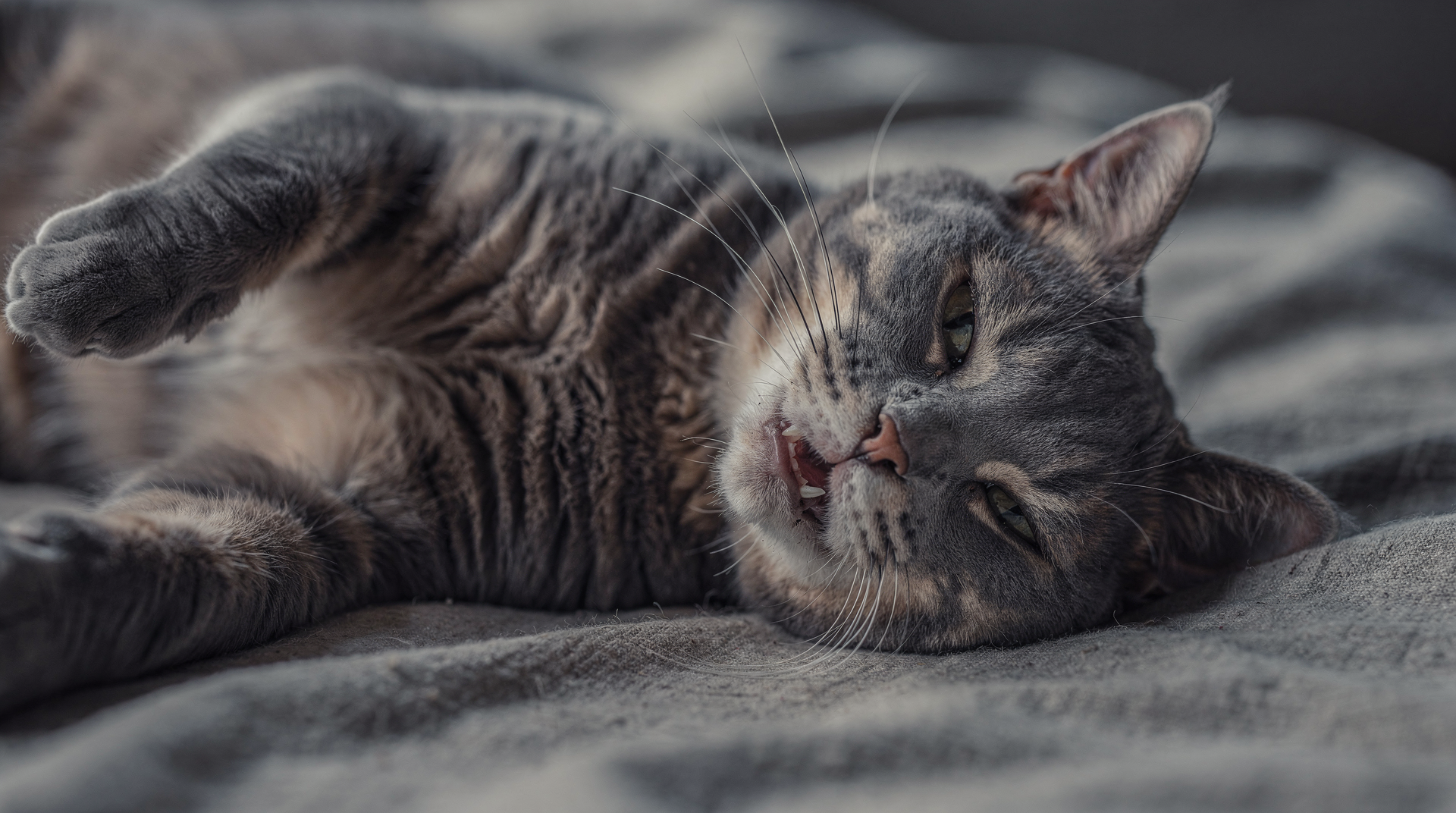
When the disease progresses, the cat’s breathing effort may no longer be subtle. The abdomen may recruit itself visibly, the nostrils may flare, and the cat may sit with the neck extended, elbows abducted, trying to maximize airflow. This posture is not dramatic theater; it’s the body’s attempt to reduce resistance in inflamed lungs. Oxygen deprivation can then produce weakness, agitation, or a glazed, distant look that owners sometimes mistake for anxiety or exhaustion. In reality, the brain is reacting to inadequate oxygen and unstable circulation. A cat may pace, vocalize, or seem suddenly disoriented, not because of behavioral defiance but because the nervous system is under metabolic siege.
The most frightening aspect of feline heartworm disease is how little predictability it offers. Dogs often carry larger worm burdens and may show chronic signs tied to adult worms residing in the heart and pulmonary arteries. Cats, by contrast, may have no adult worms at all by the time disease is recognized, because immature worms die before reaching maturity and leave behind a trail of inflammation that outlasts their physical presence. That is why negative assumptions are so dangerous. A cat can test in a way that does not neatly confirm the disease and yet still be suffering from it. The clinical picture is built from physiology, not from our wish for clarity: intermittent cough, sudden respiratory distress, vomiting, lethargy, reduced appetite, and occasionally collapse or death. Every one of those signs should be interpreted in the context of the cat’s environment, mosquito exposure, and respiratory history, because no single symptom carries the whole story.
In practical terms, the disease often announces itself through change in the ordinary choreography of feline life. The cat who once trotted to the kitchen at the sound of a can opening now arrives more slowly or not at all. The cat who used to dominate the highest shelf may pause halfway up the cat tree. The cat who tolerated being held or stroked now resists, not from hostility, but because pressure on an already compromised chest alters breathing mechanics. Even grooming may diminish; a cat that feels short of breath often abandons the exacting labor of coat maintenance, and that loss of polish can be one of the earliest visual clues that something systemic is wrong. These are not isolated quirks. They are the behavioral shadows cast by compromised cardiopulmonary function.
Because cats are designed to hide infirmity, their disease trajectory can remain invisible until a threshold is crossed. Once the threshold is reached, the shift may be abrupt: a mild cough becomes severe dyspnea, a little lethargy becomes collapse, a day of reduced appetite becomes a crisis. This volatility is why every unexplained respiratory episode in a cat living in a mosquito-prone area deserves serious attention. The parasite does not need to be a high number of to be dangerous, and the absence of a heart murmur or obvious chronic cardiac failure does not rule out substantial pulmonary injury. In feline heartworm disease, the lungs are often the true battlefield, and the cat’s apparent calm may simply be the last layer of a very thin veil.
When a cat shows any combination of coughing, labored breathing, vomiting, lethargy, fainting, or sudden behavioral withdrawal, the clock begins to matter. The proper response is not to wait and watch for a neat pattern, because feline heartworm disease rarely obliges with one. A cat that’s breathing with effort, breathing through an open mouth, collapsing, or showing a blue-tinged tongue or gums needs immediate emergency care. Those signs indicate that oxygen delivery has already become insufficient, and in cats there is no safe home remedy for that kind of respiratory compromise. Even a brief crisis can trigger irreversible injury, because feline lungs and brain tissue tolerate hypoxemia poorly. The cat who appears to recover after an episode may still be in danger, since the inflammatory cascade can continue long after the obvious distress subsides.
Call your veterinarian promptly if the signs are milder but persistent, recurrent, or simply out of character for your cat. A cough that comes and goes, an unexplained vomiting pattern, reduced stamina, or a cat who is sleeping more and interacting less deserves evaluation before the problem escalates. In feline practice, timing is everything, because the disease may be present long before the cat looks sick enough to be believed. Bring a clear history: when the coughing began, whether it follows play or excitement, whether vomiting is preceded by retching or coughing, whether the breathing changes at rest or only after activity, and whether the cat has had mosquito exposure, outdoor access, or travel history. These details matter because they help distinguish heartworm-associated respiratory disease from asthma, bronchitis, infection, pain, or gastrointestinal illness, all of which can overlap in a cat and all of which demand different treatment priorities.
Do not be reassured by a single good day. Feline heartworm disease is notorious for waxing and waning, and an episode that settles on its own can still represent serious underlying pathology. If your cat has had repeated spells of coughing, fast breathing, unexplained vomiting, or sudden weakness, testing is warranted even if the cat is currently acting normal. One must also remember that the diagnostic conversation in cats is more nuanced than in dogs; a cat can harbor disease with low worm burden, absent adult worms, or blood test results that do not tell the whole story. This is why a veterinarian may recommend a combination of chest radiographs, heartworm antigen and antibody testing, and, in some cases, echocardiography or additional diagnostics based on the clinical picture. The goal is not to chase a single perfect answer, but to assemble the physiology into a usable truth.
If a cat is in respiratory distress, keep the environment calm and quiet while you arrange transport. Do not force water, food, or medication. Do not manipulate the chest or try to restrain the cat longer than necessary, because fear and struggle increase oxygen demand at exactly the moment the body can least afford it. Transport the cat in a carrier lined with a familiar towel, and keep handling minimal. A cat in crisis needs the least excitement possible; stress itself can worsen bronchoconstriction and elevate respiratory effort. The instinct to comfort by hovering is deeply human, but in a cat with compromised lungs, stillness is often the kinder medicine until professional care is reached.
For cats with a history of respiratory episodes or those living where mosquitoes are common, preventive discussion should happen before there is a crisis. Ask your veterinarian about year-round heartworm prevention appropriate for cats in your region, because the parasite does not require an outdoors lifestyle to gain entry. The mosquito is the courier, and a single bite can be enough. Preventive care is most effective when it is routine, not reactive, and it is especially important because there is no simpler adult heartworm treatment protocol for cats comparable to the one used in dogs. Once disease is established, management becomes about limiting inflammation, supporting breathing, and surviving the parasite’s unpredictable course rather than simply killing adult worms.
Owners should also become fluent in their own cat’s resting respiratory rate and body language. Count breaths when the cat is asleep or fully relaxed; an increase over the cat’s normal baseline can be an early clue, particularly if paired with reduced appetite, hiding, or decreased activity. Notice whether the cat prefers cooler surfaces, changes sleeping positions to keep the chest less compressed, or avoids jumping in a way that suggests exertional strain. The cat’s threshold for asking help is high, but the body broadcasts distress in small, repeatable alterations long before it shouts. Catching those alterations early is the difference between a manageable workup and an emergency.
A cat does not need to appear dramatically ill to deserve immediate assessment, and that is the great trap of this disease. The guardian who waits for a textbook presentation may miss the brief window when intervention can prevent a catastrophic decline. When the signs involve breathing, collapse, or repeated unexplained vomiting, the right course is to act at the same time. When the signs are quieter but persistent, the right course is still to act, because in the feline patient a whisper can be the opening line of a very dangerous story.