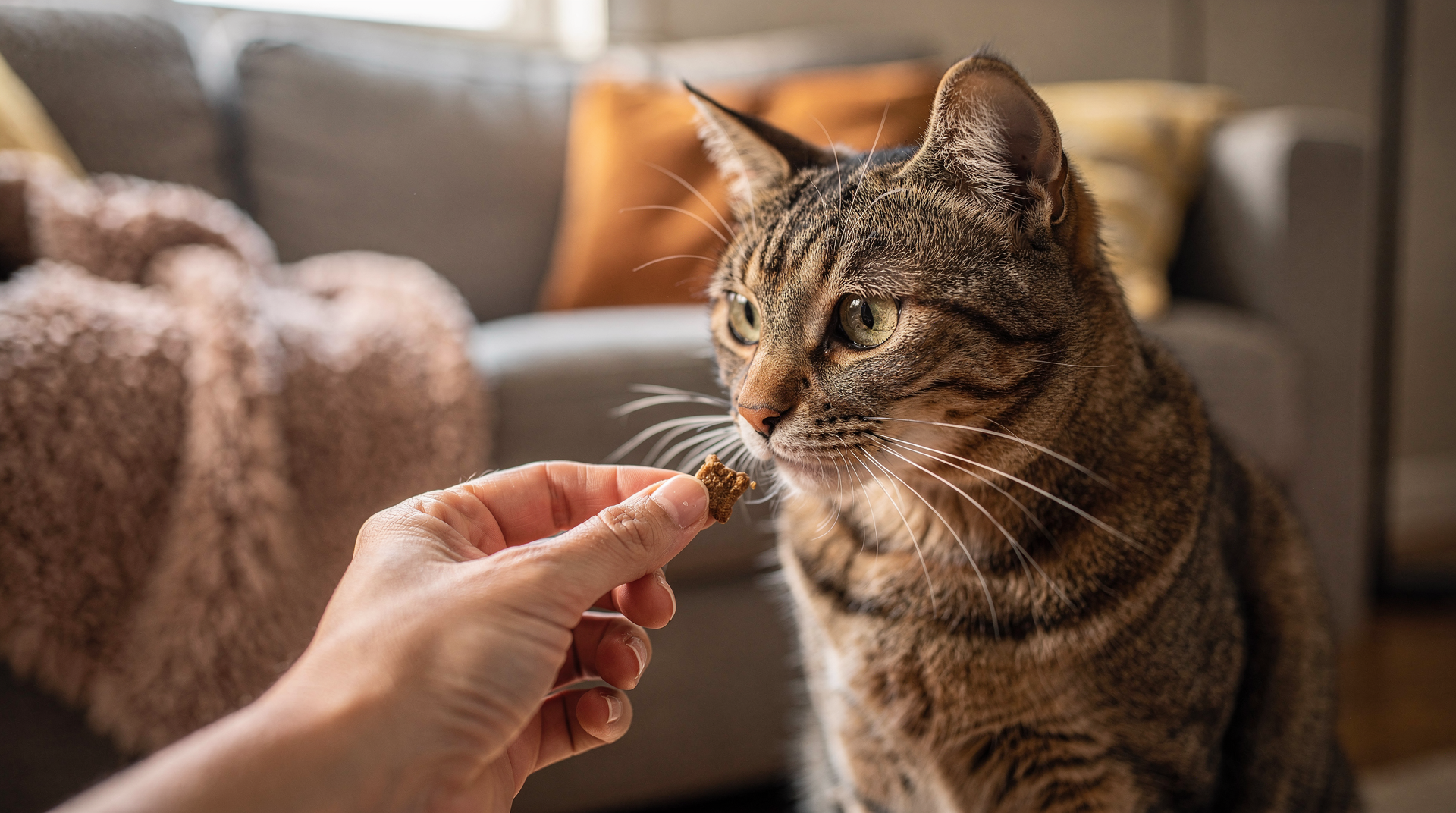
Use reinforcement that competes with the cat’s actual reward system: food, access, play, scent marking, and control over distance. Cats learn fastest when the consequence arrives within 1–2 seconds of the desired behavior and is paired with something they already value. For many cats, a tiny high-value treat works better than a full meal reward because the response is driven by immediate salience rather than volume. For overweight, diabetic, or food-motivated cats, shift part of the daily ration into training pieces so reinforcement does not overshoot caloric needs; for cats with reduced appetite, use lickable diets, freeze-dried meat, or a short wand-toy session as the paycheck.
Reinforce the exact behavior you want, not a nearby approximation that could later create confusion. If a cat comes when called, mark the first orientation of the head, then the approach, then the arrival at your feet, then the sit or nose-touch if that’s the final behavior you want. This prevents rewarding frantic sprinting, nipping at ankles, or jumping on counters after the cue. A consistent marker word such as “yes” or a clicker can bridge the gap between the behavior and the reward, especially in cats that hesitate before taking food. The marker must mean one thing only: that exact behavior earned a payoff.
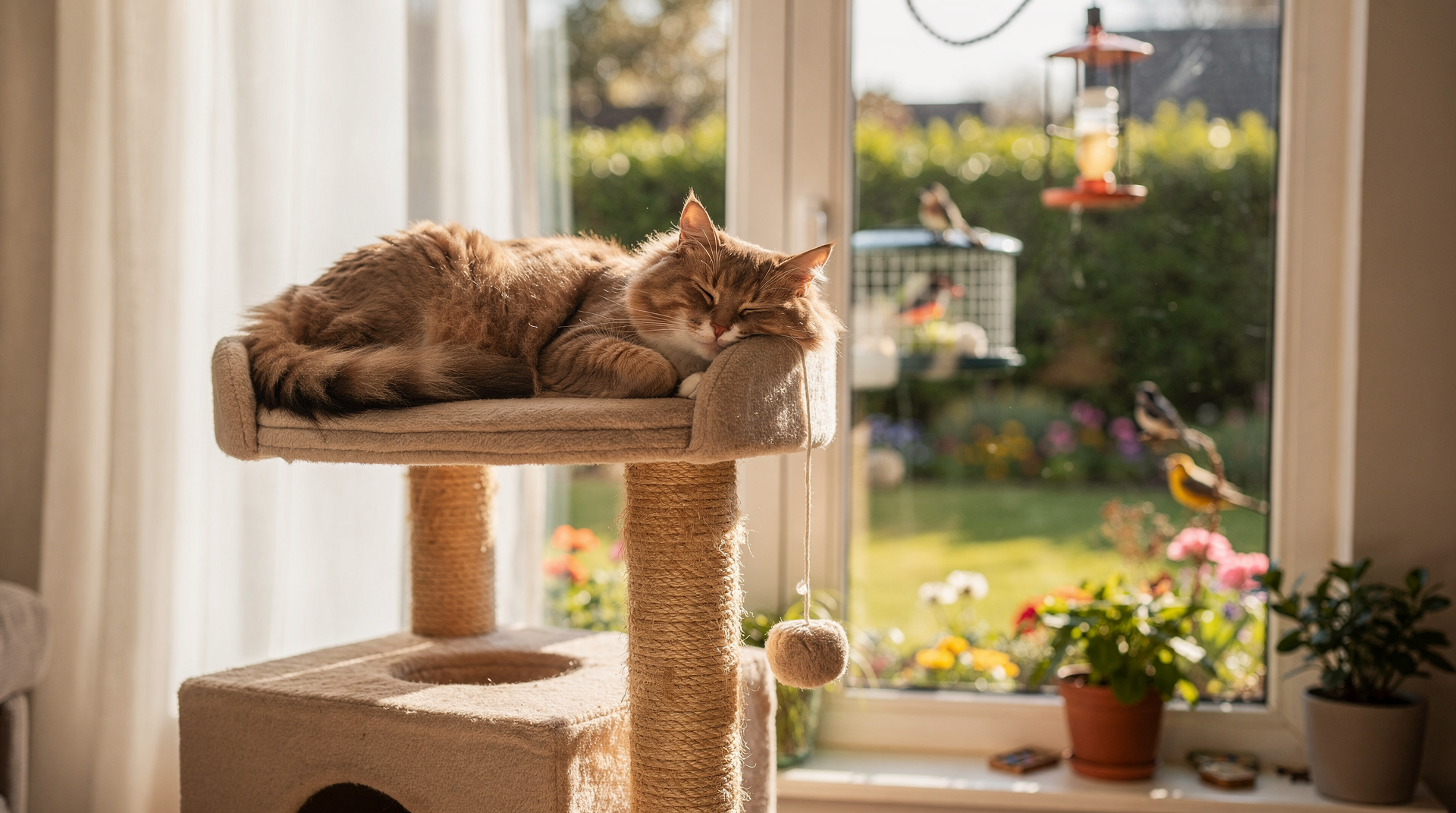
Environmental reinforcement matters as much as edible rewards. A cat that scratches the sofa is often self-reinforcing because the location offers vertical grip, scent deposition, and social visibility. Redirect to a taller, sturdier scratching post placed where the cat already scratches, and make the correct surface easier to win by adding catnip, silver vine, or a hanging toy to the post. If the cat uses the post, immediate reinforcement should follow: a treat, praise paired with play, or access to the room the cat wanted. The reward must arrive before the cat drifts away to another activity, or the learning signal weakens.
Play is one of the most effective reinforcers for hunting-driven cats and kittens, especially for behaviors like moving off forbidden surfaces, settling on a bed, or entering a carrier voluntarily. Use brief prey-style sequences: stalk, chase, catch, then a small food reward to complete the predation loop and reduce frustration. This matters because unfinished hunt behavior can convert into biting, zooming, or nighttime vocalization. For fearful cats, keep the game low intensity and predictable; overstimulation can flip arousal into defensive aggression, which looks like “bad behavior” but is really a nervous system overload.

Purina Tidy Cats 24/7 Performance Clumping Cat Litter, 16 lb Bag | Clean Linen scent with 24/7 slow-release deodorizer in a smaller, easy-pour size
EUR 10.91 (as of September 22, 2026 14:28 GMT +00:00 - More infoProduct prices and availability are accurate as of the date/time indicated and are subject to change. Any price and availability information displayed on [relevant Amazon Site(s), as applicable] at the time of purchase will apply to the purchase of this product.)Shaping works best for cats because it respects their need for agency. Reward tiny steps toward the target behavior, such as glancing at the carrier, approaching it, stepping inside, and finally relaxing inside with the door open. Forced exposure usually increases avoidance and can poison the context, especially in cats with prior travel stress or veterinary trauma. If a cat freezes, pupils dilate, tail lashes, or the body crouches low, lower the criteria immediately; those are signs the threshold is too high and the cat is no longer learning efficiently.
In multi-cat homes, reinforce the calm cat separately so one animal does not steal the other’s reward and intensify conflict. Cats learn socially from repeated outcomes, not from moral correction, so rewarding quiet coexistence, using separate stations, and feeding at predictable distances lowers resource tension. Never reward proximity if either cat is stiff, staring, blocking, or overgrooming after the interaction; those are not signs of friendship but of unresolved pressure. The cleanest reinforcement in feline behavior is precise, immediate, and tailored to the individual cat’s motivators, health status, and stress threshold.
The most damaging mistake is punishing after the fact. Cats do not connect delayed consequences with an earlier action the way humans do, so yelling at a cat found on the counter, rubbing a nose in urine, or swatting for a scratch only teaches that your presence predicts danger. That shifts the cat’s emotional state from curious to defensive, which increases hiding, redirected aggression, and elimination outside the box. When a cat appears “guilty,” the posture is usually a response to your tone, posture, and movement, not a memory of the act itself.
Physical punishment is especially toxic because feline learning is tightly linked to predictability and safety. A cat that is hit, grabbed, scruffed, or shoved away may suppress the visible behavior in front of you while intensifying it when you’re absent. That’s why punishment often fails with scratching, jumping, and counter surfing: the cat learns to avoid the punisher, not the behavior. Repeated aversive handling can also create a conditioned fear response to hands, which raises the risk of bite inhibition breakdown during grooming, medication, or veterinary care.
Noise-based deterrents are another common error when used as primary training. Sprays, loud claps, shaker cans, and motion alarms may interrupt a behavior in the moment, but they do not teach the replacement behavior the cat should choose next. In sensitive cats, especially kittens, seniors, and cats with existing anxiety, unpredictable noise can sensitize rather than deter, producing vigilance, startle responses, and sleep disruption. If an interruption is needed, it should be brief, low-intensity, and immediately followed by redirection to a reinforced alternative.
Inconsistency sabotages training faster than most owners realize. If a cat is allowed on the bed sometimes, on the counter sometimes, and then punished only when a person is stressed, the environment becomes impossible to read. Cats form habits around what reliably works, so mixed rules create perseveration, not clarity. Every household member must enforce the same boundaries, using the same cue words, the same barriers, and the same reward timing, or the cat will simply keep testing the pattern.
Another error is removing the reward but leaving the cause. If a cat jumps on a table for attention, food access, warmth, or a better view, punishment without changing the function of the behavior guarantees repetition. Ask what the cat is obtaining: elevation, security, social contact, prey view, or access to resources. Then replace the payoff with a legal version—cat tree near the same sightline, elevated perch by a window, scheduled play, or a feeding puzzle placed away from the forbidden zone. Eliminating the behavior without meeting the underlying need creates relapse.
Do not use isolation as a reflexive punishment. Confining a cat after a “bad” act can amplify anxiety if the cat already associates the carrier, bathroom, or spare room with stress. Time-out only works when the space is neutral, brief, and paired with a clear path to success afterward; otherwise it becomes random social exile. For cats that are vocal, clingy, or destructive when confined, the real issue is often under-stimulated arousal, insufficient territory, or unresolved medical discomfort, not defiance.
- Never punish elimination accidents; first rule out urinary inflammation, constipation, pain, litter box aversion, or territorial marking.
- Avoid chasing or cornering; it intensifies fear and can convert a manageable behavior into aggression.
- Do not reward the wrong moment; attention during meowing, pawing, or countertop exploration can strengthen the behavior you want to reduce.
- Do not ignore pain; arthritis, dental disease, dermatitis, and hyperthyroidism frequently masquerade as “behavior problems.”
- Do not assume one strategy fits all cats; age, breed tendencies, prior trauma, and reproductive status alter thresholds, motivation, and tolerance.
Breed-linked tendencies matter here. Bengals, Abyssinians, and other high-drive cats often need more structured predatory outlets; punishment for climbing or speed increases frustration because the behavior is rooted in genetics, not insolence. Ragdolls and other lower-arousal cats may appear compliant but can become avoidant if corrections are harsh. Seniors with cognitive decline may repeat unwanted behaviors because of disorientation, not stubbornness, while intact males may spray or roam from hormonal pressure that no amount of scolding will fix. When the behavior has a physiological driver, discipline without diagnosis is just noise.